Ask the Jeweler
Lab-Grown or Natural?
The Only Honest Answer
A McLean master jeweler on the question every couple asks first, and why nobody should answer it for you.
The short answer: a laboratory-grown diamond and a natural diamond are both diamonds — same crystal, same hardness, same fire. They differ in origin, rarity, documentation, and what they cost relative to each other. Neither is the “right” choice. The right choice depends on what the stone means to you, and anyone who answers before asking about that is selling you their inventory, not advice.
I say this as someone who makes rings with both, every week, in my studio in McLean. Here is what I actually tell couples across the bench.
What’s Identical
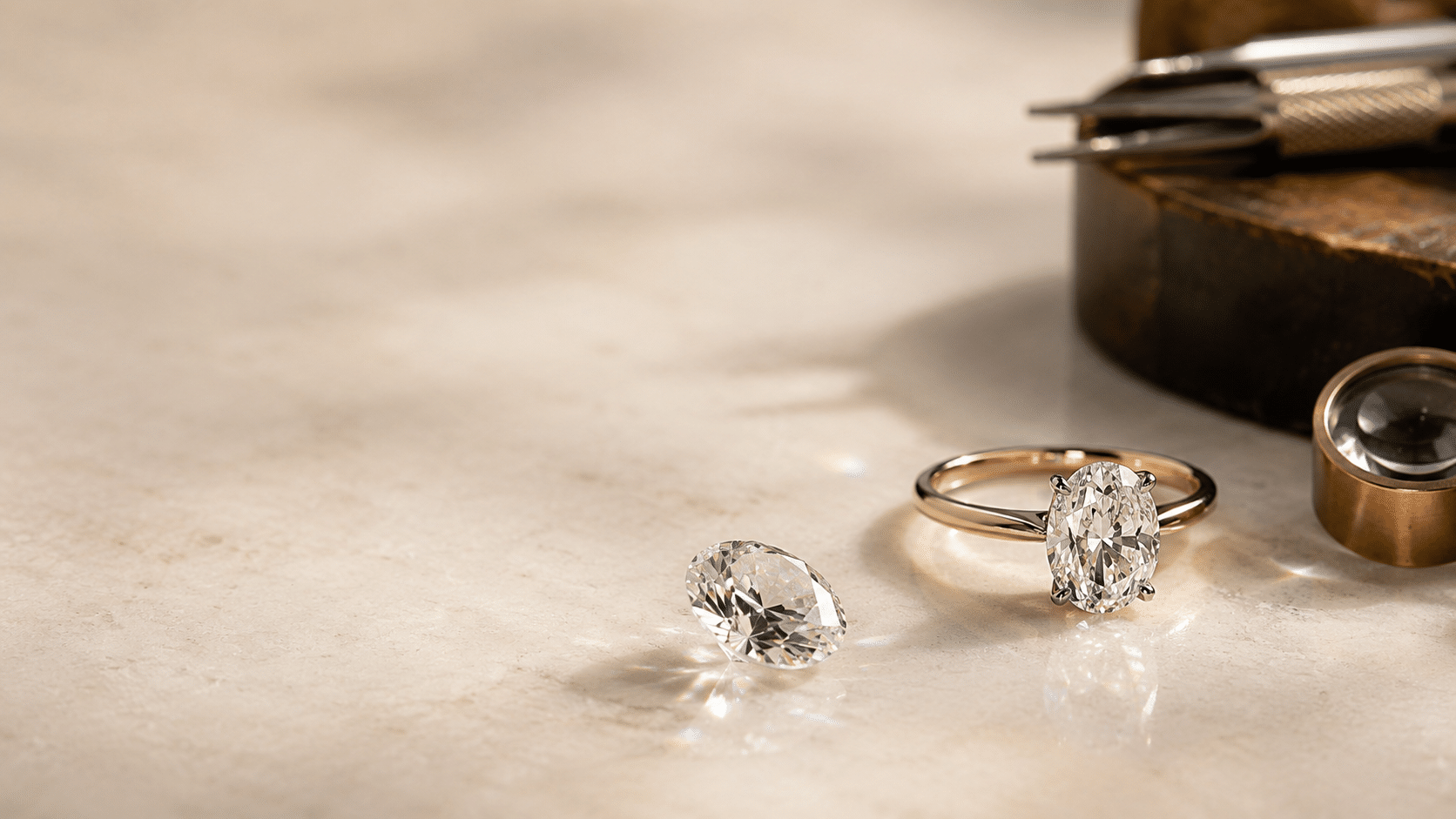
A laboratory-grown diamond is not an imitation like cubic zirconia or moissanite — those are different materials entirely. It is carbon crystallized into diamond, grown above ground instead of below it. Set two well-cut stones of similar grade side by side and neither I nor you will tell them apart by eye. Both take the same settings, the same care, the same polish. Both are graded on the same 4Cs.
“Neither is automatically the right choice. The right choice depends on what the stone means to you.”
What’s Genuinely Different
Origin and rarity. A natural diamond formed over roughly a billion years and was found, not made; there is a finite amount of it, and that scarcity is part of what you are buying. A laboratory-grown diamond was created in weeks using one of two methods — HPHT, which mimics the earth’s pressure and heat, or CVD, which builds the crystal layer by layer from carbon gas. Because they can be produced, they are not scarce, and their relative prices have moved accordingly over recent years. Two honest consequences: the same budget buys a noticeably larger or higher-grade laboratory-grown stone today, and a laboratory-grown stone should not be bought as a financial store of value.
The Paperwork Question
Whichever you choose, insist on a grading report from an independent laboratory such as GIA or IGI — and note the word report. Laboratories grade diamonds; they do not “certify” them, and they do not appraise them, whatever a sales floor tells you. The report describes the stone: its 4Cs, its measurements, and — for laboratory-grown diamonds — a clear disclosure of origin, usually laser-inscribed on the girdle. At our studio every diamond, grown or natural, comes with its report, and I will happily walk you through every line before you decide anything.
ALICIA’S LENS
One couple came into the studio certain they wanted a natural diamond. After looking at both options side by side, they realized that maximizing cut and size mattered more to them than origin. Seeing the stones together gave them the confidence to make the decision for themselves.
— Alicia Villars
How Couples Actually Decide
After hundreds of these conversations, the pattern is simple. Couples who choose natural usually say some version of: it existed before us, and that matters to me. Couples who choose laboratory-grown usually say: I’d rather put the difference into the cut, the size, or the honeymoon. Both are excellent reasons.
Both make beautiful rings. The only wrong answer is choosing under pressure, from a case, in a hurry.
Three Questions to Bring to Any Jeweler
- Will you show me a laboratory-grown and a natural stone of similar grade side by side — and am I free to walk away? Any good jeweler says yes to both.
- Does this stone come with an independent grading report, and will you review it with me line by line?
- If I change my mind about origin during a custom design, does the design change — or just the stone?
Because we design factory-direct — the piece is made through our direct manufacturing partner, not pulled from showroom inventory — the design and the stone are separate decisions at Helvetia. You can fall in love with the ring first and choose its diamond second, without starting over.

ABOUT ALICIA
Alicia is co-founder and master jeweler at Helvetia Jewelry in McLean, backed by three generations of jewelry knowledge.
Private consultations in studio or virtually: helvetiajewelry.com.